Featured reader tool IC 100
What do 100 companies say about AI?
Trace language about AI agents, models, compute and pricing across annual filings. Open the passages, inspect company figures and check the published selection rule.
Featured book
Coming Soon!
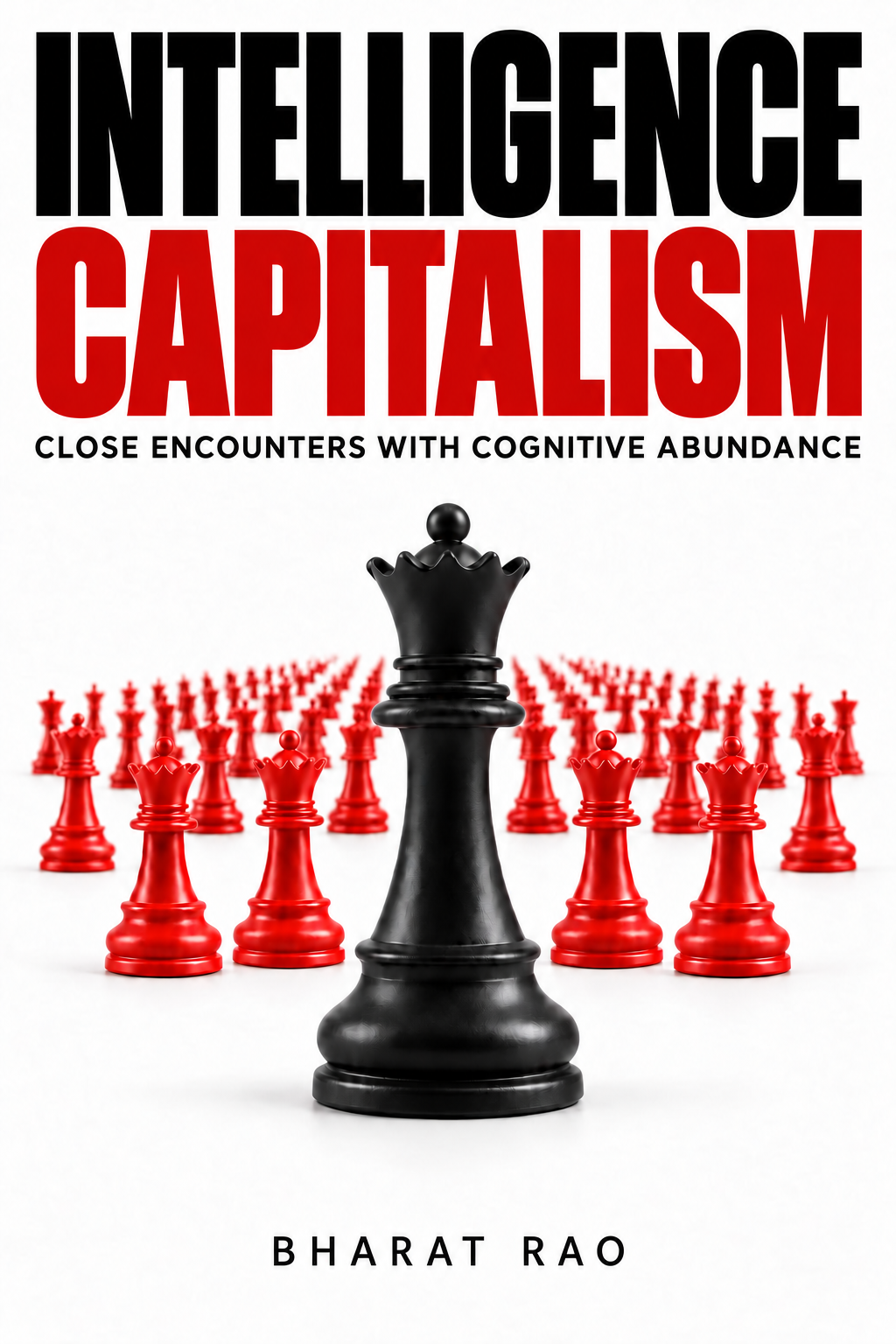
Intelligence Capitalism
Close Encounters with Cognitive Abundance
The old arithmetic of business is breaking down. For more than a century, growth usually meant adding employees, managers, and layers of coordination. Artificial intelligence is weakening that link. Under the right conditions, firms can expand revenue and productive capacity without expanding direct payroll at the same rate.
Intelligence Capitalism examines what happens when machine intelligence becomes infrastructure and routine coordination becomes programmable. Through case studies spanning healthcare, design, software, law, media, scientific research, logistics, finance, and robotics, it shows why the most consequential business effect of artificial intelligence may not be on the automation of individual tasks, but on the compression of the organization itself. Competitive advantage increasingly depends on how effectively a firm directs machine capability around assets that remain scarce: customer relationships, proprietary context, trust, judgment, and accountability.
At the center of this transformation is the machine-scale firm, an emerging organizational model with three operating layers. It protects the customer relationship, automates the operational middle, and rents standardized, capital-intensive, or regulated infrastructure where ownership does not create a stronger competitive position. Human judgment governs the system across all three layers by setting objectives, defining boundaries, resolving exceptions, and accepting responsibility when the system fails. Companies that assemble this architecture well can achieve levels of speed, reach, and productive capacity once reserved for much larger institutions.
Machine scale does not make labor or responsibility disappear. It redistributes work across software, employees, contractors, specialized providers, and a narrower human core. Accountability contracts more slowly than headcount.
Cognitive abundance also carries profound contradictions. As intelligence becomes cheaper, capabilities converge and margins compress. Lean firms become dependent on a concentrated layer of model, cloud, chip, and platform providers. Autonomous agents create new security and privacy exposures. Entry-level work is hollowed out, weakening the apprenticeship systems through which organizations produce future experts and accumulating what the book calls judgment debt. Firms can restructure within months, while governments, universities, and labor markets may require years to respond.
Beyond the firm, these changes could deepen inequality, concentrate economic power, divide economies between machine-scale and human-scale sectors, and destabilize professional identities. They could also force societies to reconsider how income, opportunity, status, and security should be distributed when human labor is no longer the principal constraint on production. Even technically successful systems may fail the legitimacy test if customers, workers, regulators, and the public cannot determine who remains answerable for their decisions.
Intelligence Capitalism offers executives and boards a practical framework for redesigning work, proving operating value, controlling delegated authority, managing infrastructure dependence, and preserving the human judgment on which durable institutions depend. Written for business leaders, managers, policymakers, and general readers who want to understand not simply what artificial intelligence can do, but how it will alter the economics of the firm, redistribute power, and reshape competition in an age of cognitive abundance.
Newsletter and access
Get launch updates on Intelligence Capitalism.
Enter your details below to be notified when the book is available, along with other Core Loop Press notes.
Occasional updates about this title and Core Loop Press. No spam, unsubscribe any time.